
Build a Resume
That Opens
Luxury Doors
Expert tools, templates & industry insights to help hospitality professionals present their experience with impact.
The Strategic Architecture for Luxury Hotel Resumes
A Comprehensive Masterclass Blueprint for Mid-to-Senior Operations Hospitality Leaders
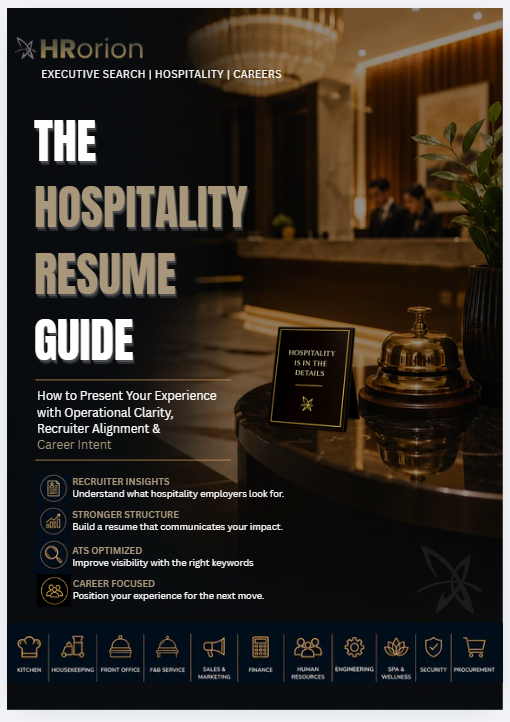
Stop using generic objective statements that fail to differentiate your profile.
Luxury hotel HR managers and corporate recruiters often scan resumes in under 6 seconds. This guide explains the exact Three-Zone Architecture used to communicate operational scale, financial impact, and technical systems expertise more effectively.
Recruiter Alignment Matrix
Understand exactly how senior hotel management and talent acquisition teams filter leadership profiles.
The Three-Zone Architecture
Learn how to cleanly segment your profile into high-impact zones: The Hook, The Proof, and The Enablers.
ATS & System Keyword Calibration
Discover how to integrate critical platform terms (Opera PMS, Micros, HotSOS) naturally so your resume clears automated screeners.
Action-Verb Achievement Formulas
Shift your wording from basic daily duty lists to highly quantifiable business milestones that highlight ROI and guest satisfaction metrics.
| Kitchen | Housekeeping | F&B Service | Front Office |
|---|---|---|---|
| HACCP Compliance & Food Safety Standards | OCC% & Room Inventory Management | Average Check (AC) & Cover Count Management | Opera PMS & Channel Management |
| Food Cost Optimization & Yield Management | Linen & Laundry Cost Control | Outlet P&L & Beverage Cost Control | RevPAR & ADR Optimization |
| Menu Engineering & Recipe Standardisation | Room Discrepancy Report | Sequence of Service & SOP Implementation | Night Audit & Revenue Reconciliation |
| Cost per Cover & Portion Control | Preventive Maintenance Coordination | Upselling & Revenue Per Cover Growth | Walk-in Conversion & Upselling Rooms |
| Culinary Brigade Management | Turn-down & VIP Room Setup | Reservation & Table Management | OTA & GDS Management |
| Kitchen Stewarding Oversight | Lost & Found Protocol Management | Guest Satisfaction Score (GSS) Tracking | Yield & Occupancy Management |
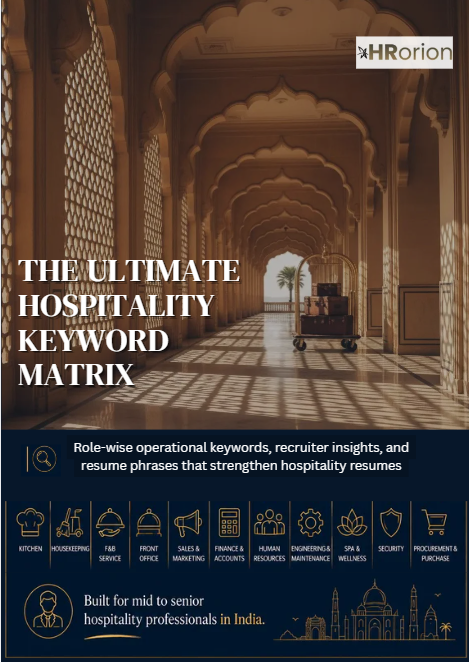
Looking for the complete 11-department operational matrix?
The preview above highlights core operational benchmarks across major hotel functions. To access recruiter-aligned keywords, leadership exposure, systems knowledge, revenue metrics, and software platforms across all hospitality departments—including Sales & Marketing, Finance, Human Resources, Engineering, Procurement, Spa, and Security—download the complete HRorion Keyword Matrix Guide below.
Use hospitality-specific operational keywords to improve resume visibility across Applicant Tracking Systems (ATS) and recruiter screening workflows.
Guides & Tools to Strengthen Your Profile
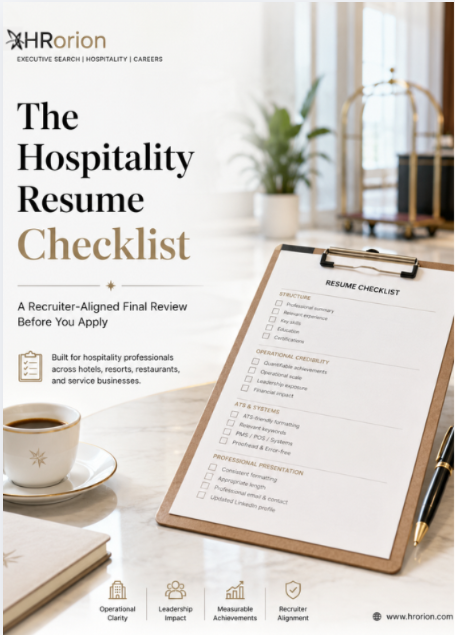
Resume Checklist
Make sure your resume has everything it needs to impress recruiters and hiring managers.
Resume Tips /FAQs
Proven tips to help you optimize your professional profile, pass automated screening bots, and present your leadership experience confidently.
How do I structure my career achievements to pass automated ATS filters?
Most premium hotel groups use Applicant Tracking Systems (ATS) to screen resumes before a recruiter reviews them manually. To improve ATS visibility, avoid overly designed layouts, graphic skill bars, tables, and decorative icons that software often struggles to read correctly. Instead, structure your achievements using operational keywords combined with measurable business impact. A strong hospitality achievement usually follows this structure: Action Verb + Operational Objective + Quantifiable Result. Recruiters respond far better to “Reduced banquet food variance by 4.2% across three outlets” than generic responsibility statements.
What operational metrics do luxury hotel brands expect to see on a resume?
Hospitality recruiters evaluate professionals based on the scale of operations they have managed. Your resume should clearly communicate measurable exposure across revenue, guest experience, team leadership, and operational performance. Rooms professionals should mention inventory size, occupancy percentages, ADR, RevPAR exposure, and guest satisfaction metrics. Culinary and F&B professionals should include outlet counts, banquet capacities, annual revenue handled, food cost optimization, and operational scale. Across all departments, metrics help recruiters immediately understand the complexity and standards of the environment you have worked within.
How should I address employment or caregiving gaps in my timeline?
Hospitality recruiters generally value professionalism, clarity, and confidence more than perfectly uninterrupted career timelines. If you stepped away for family responsibilities, caregiving, health, relocation, or personal reasons, address it briefly and professionally without over-explaining. A simple timeline entry such as “Career Sabbatical — Family Responsibilities” is usually sufficient. During interviews, acknowledge the gap confidently and redirect the discussion toward your operational experience, leadership capabilities, and long-term career direction.
Should hospitality resumes be creative or ATS-friendly?
For most hospitality roles, especially within branded and luxury hotel environments, clarity is more important than excessive design. A clean and professionally structured resume usually performs better than highly graphic-heavy layouts. Recruiters typically scan resumes quickly, so strong hierarchy, operational clarity, measurable achievements, and readable formatting matter more than visual decoration. Well-designed resumes are valuable, but the structure should always support recruiter readability and ATS compatibility first.
How long should a hospitality resume ideally be?
Mid-level hospitality professionals should ideally maintain a two-page resume, while senior leadership professionals with extensive operational exposure can extend to a maximum of three pages. The focus should always remain on relevance and operational impact rather than documenting every responsibility from earlier stages of the career. Your most recent and strategically important roles should receive the greatest detail, especially if they involve leadership exposure, revenue responsibility, pre-opening operations, or luxury brand experience.
What are the biggest mistakes hospitality professionals make on resumes?
What are the biggest mistakes hospitality professionals make on resumes?
One of the most common mistakes is writing generic responsibility-based statements instead of measurable operational achievements. Recruiters also frequently see missing property context, inconsistent formatting, poor ATS compatibility, outdated email addresses, and resumes that fail to mention operational scale or systems exposure. Another major issue is the excessive use of generic soft skills such as “hardworking” or “team player” without operational evidence to support them. Strong hospitality resumes communicate business impact, operational standards, leadership exposure, and measurable results clearly and professionally.
Should I include every hotel I have worked with on my resume?
Not necessarily. Hospitality resumes should focus more on relevance and operational progression rather than documenting every short-term role from earlier stages of your career. Prioritize positions that demonstrate stronger leadership exposure, operational scale, luxury brand standards, pre-opening involvement, or measurable business impact. If multiple earlier roles were similar in responsibility, they can be grouped briefly to maintain clarity and resume length control.
How important is LinkedIn for hospitality professionals today?
LinkedIn has become increasingly important for mid-to-senior hospitality hiring, especially across luxury hotels, corporate offices, pre-opening projects, and leadership recruitment. Recruiters often review LinkedIn profiles alongside resumes to evaluate professional credibility, operational progression, industry presence, and communication standards. A clean profile with an updated headline, property exposure, leadership achievements, and professional presentation helps strengthen overall recruiter perception before the interview stage.
HRorion Recommended Hospitality Resume Formats
Designed specifically for hospitality hiring workflows and recruiter screening standards.
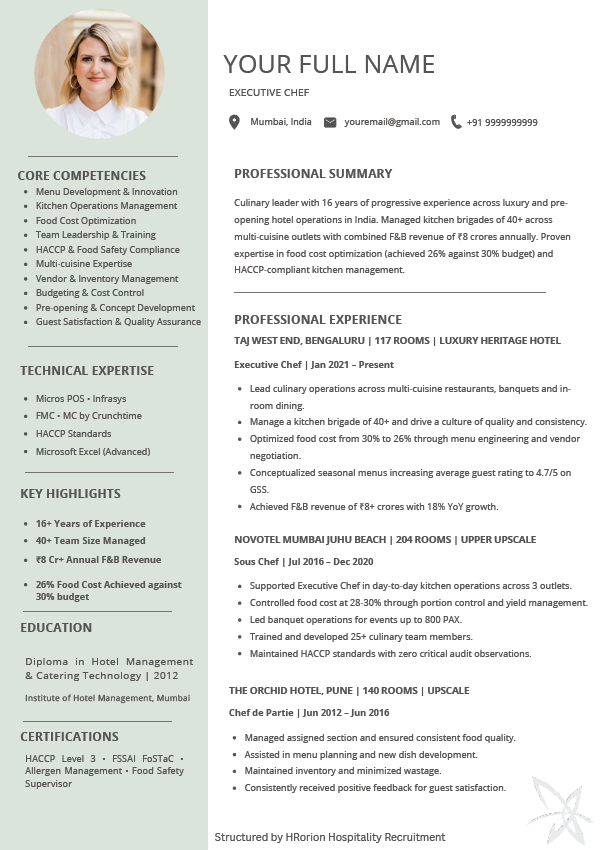
EXECUTIVE / LUXURY LEADERSHIP VERSION
Best for: Department Heads, Managers, Senior Executives & Leadership Roles
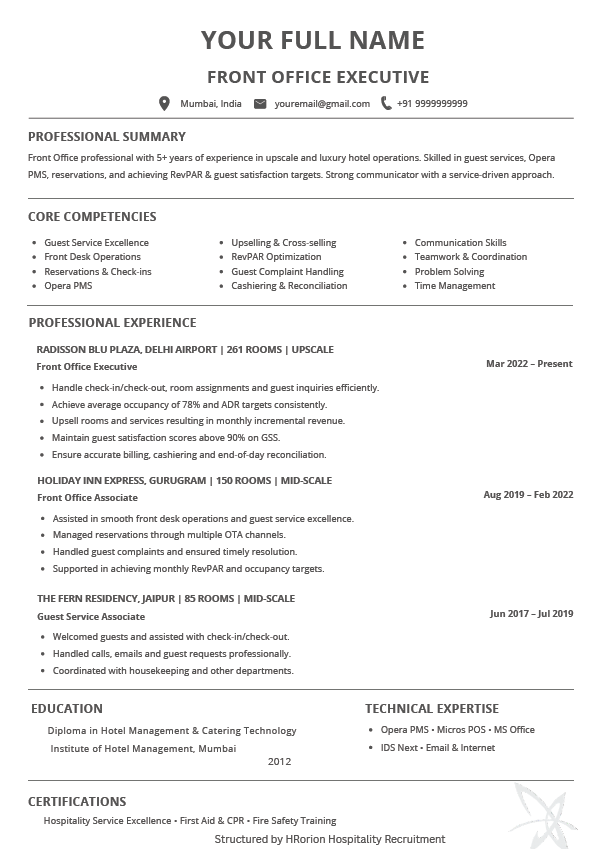
OPERATIONAL / ATS-FOCUSED VERSION
Best for: Supervisors, Executives, Associates & Operational Roles
Want Us to Do It for You?
Too busy to format it yourself? Let our senior hospitality recruiters rewrite and align your resume to modern luxury hotel standards.
Call or WhatsApp 9041002999 to get started.