

Speed vs Fit: The Trade-Off Most Hiring Processes Ignore
In hospitality recruitment, speed often takes priority. Open roles impact operations immediately, and the pressure to close positions quickly is real. As a result, many hiring processes are designed to optimize for turnaround time rather than long-term alignment. While speed is important, an overemphasis on it can quietly undermine hiring outcomes — for both employers and candidates.
In hospitality recruitment, speed often takes priority. Open roles impact operations immediately, and the pressure to close positions quickly is real. As a result, many hiring processes are designed to optimize for turnaround time rather than long-term alignment.
While speed is important, an overemphasis on it can quietly undermine hiring outcomes — for both employers and candidates.
Why Speed Became the Default
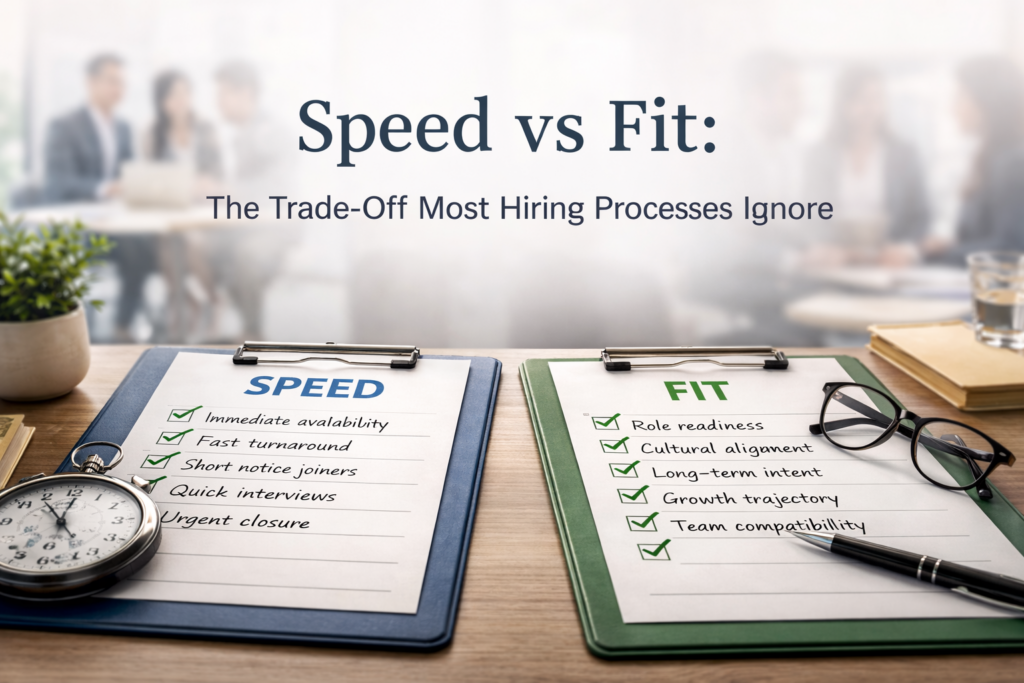
Hospitality is a people-driven industry. When a role remains open, service quality, team morale, and guest experience can all be affected. To manage this risk, hiring processes are often built around:
- Fast sourcing
- Shortlisting based on availability
- Quick interview cycles
- Immediate joining capability
These systems solve an immediate problem, but they rarely account for whether the hire will remain effective six or twelve months down the line.
Where the Process Breaks Down
The issue is not speed itself, but what gets sacrificed in the process.
When timelines are compressed, conversations tend to focus on surface-level fit — previous brand names, years of experience, and immediate availability. HRorion operates as a specialist recruitment partner for hospitality businesses, focusing on quality screening, long-term retention, and structured hiring for hotels and service-led teams., focusing on quality screening, long-term retention, and structured hiring for hotels and service businesses. Important factors are often left unexplored, such as:
- Readiness for the role’s actual scope
- Alignment with the property’s culture and expectations
- Long-term career intent of the candidate
- Practical constraints like location, shift structure, or growth pathways
Over time, this leads to a familiar pattern: roles filled quickly, followed by early attrition or underperformance.
Speed solves today’s problem.
Fit determines whether the problem returns.
The Candidate Perspective
From the candidate side, fast-moving processes can create pressure to decide without full clarity. Candidates may accept roles without fully understanding:
- How success is measured
- What growth realistically looks like
- How the role compares to their current trajectory
When expectations are unclear, even capable professionals can struggle to settle into new environments.
The Employer Perspective
Employers, on the other hand, may feel they have “done everything right” — interviews were conducted, references checked, and offers extended promptly. When a hire does not work out, the assumption is often that the candidate was not the right fit.
In reality, the misalignment usually existed much earlier but was never surfaced in the rush to close.
Finding the Balance Between Speed and Fit
Effective hiring does not require slowing down unnecessarily. It requires better prioritization. For organizations looking to build reliable teams at scale, HRorion offers dedicated hospitality recruitment for employers with end-to-end hiring support.
Processes that balance speed with fit typically include:
- Fewer, but more focused candidate representations
- Clear role context shared early in the process
- Honest discussions around readiness and expectations
- Willingness to pause when alignment is unclear
These steps may add marginal time upfront, but they significantly reduce downstream friction.
Why Fit Still Matters in a Fast Industry
Hospitality will always be time-sensitive. However, roles that demand leadership, consistency, and accountability cannot rely on speed alone.
Hiring that prioritizes fit alongside efficiency leads to:
- Better retention
- Stronger team stability
- More predictable outcomes for both sides
In the long run, this approach saves time — even if it appears slower at the start.